 Plutusdao
 plsAssets separate liquid reward exposure from underlying locked positions
· last updatedPlutusdao plsAssets are liquid wrappers for underlying staked or locked positions, giving holders access to rewards through Plutus, formerly PlutusDAO. The wrapper can trade while its backing remains committed to the underlying protocol. Single-token staking and supported liquidity pools determine how holders receive rewards. Market demand sets the wrapper's exchange rate, so liquidity does not promise a 1:1 sale price. Each product also has its own backing asset, governance treatment and operating status.
Table of contents
Key takeaway: Converting xPLUTUS into plsPLUTUS gives liquid yield exposure while surrendering the converted tokens' governance rights.
Locked Backing and Pooled Voting
Plutus keeps the yield-producing position committed to its underlying protocol while the plsASSET token circulates separately. The backing supplies economic exposure, and staking distributes earnings to eligible positions. Selling the wrapper transfers that exposure without releasing the underlying lock.
A wrapper also changes who exercises governance rights because Plutus aggregates the underlying voting power through xPLUTUS stakers. Converting a governance-bearing token therefore exchanges direct control of that position for liquid reward exposure. Holding its wrapper does not grant the same direct vote over the underlying protocol.
Distinct Backing Across the Wrapper Family
plsGRAIL, plsSYK and plsSPA connect different governance positions to the same wrapper architecture, with each underlying partner determining which earnings support its rewards.
Camelot, Stryke and Sperax Positions
Camelot supplies the xGRAIL position behind plsGRAIL, with distributions to stakers in GRAIL, while Stryke supplies xSYK exposure for plsSYK. Sperax supplies veSPA exposure for plsSPA, including the yield tied to that locked governance position. These assets share a wrapper model while retaining different underlying economies. A change in one partner's rewards changes that wrapper's earnings; it does not establish reward terms for the other wrappers.
Berachain and Ethereum Positions
plsBERA and plsKDK extend the family on Berachain, where plsBERA draws yield from sWBERA and KDK conversion creates xKDK backing for plsKDK.
On Ethereum, plsCYPH wraps exposure to Cypher's xCYPH staking position. Plutus announced its launch on August 7, 2026, with single-token staking and staking rewards for a dedicated plsCYPH pool live. The wrapper can transfer or trade while the underlying position supplies staking rewards. That market liquidity gives a different exit mechanism from redeeming xCYPH through its own vesting process.
Staking Rewards and Pool Liquidity
Single staking and liquidity provision give holders different positions in the reward system. A supported liquidity pool token represents exposure to the pool assets and eligibility for its configured reward allocation.
Single-Token Positions
Single-token staking places a supported plsASSET in its reward contract, where rewards accrue while the position remains staked. The underlying protocol supplies the earnings, so the wrapper remains exposed to interruptions in that protocol's reward stream.
Liquidity Pool Positions
Liquidity pool staking uses a supported LP token representing an asset-wrapper pair. GRAIL-plsGRAIL, SYK-plsSYK and SPA-plsSPA are documented combinations. Eligible LP staking and single staking draw from the same reward pool under the configured split.
The Paired Assets
An LP position contains exposure to both sides of its pool. Plutus can distribute wrapper rewards through eligible LP staking, while the pool's incentive arrangements govern additional rewards. The Q1 2025 report described approved SPA incentives from Sperax for the SPA-plsSPA Demeter farm.
The Reward Split
Plutus shifts rewards between single staking and eligible LP staking as pool conditions change. Lower wrapper swap rates can direct a larger share toward single staking. Stronger swap rates can increase the LP allocation. Each position's share changes with that allocation, even when total underlying earnings stay unchanged.
The plsPLUTUS Conversion Boundary
plsPLUTUS wraps Plutus's own xPLUTUS position and gives its reward exposure a tradable form. Its conversion rules allow xPLUTUS to convert into plsPLUTUS and plsPLUTUS to convert back into xPLUTUS at 1:1. Holders surrender the governance rights of converted xPLUTUS while taking the wrapper's yield exposure.
That conversion ratio describes these two tokens and does not fix the PLUTUS-plsPLUTUS pool price. Returning to xPLUTUS leaves the holder with xPLUTUS, whose separate redemption rules govern conversion into PLUTUS. Selling plsPLUTUS in a liquidity pool follows the available market quote.
Conversion Prices and Market Entry
Market entry buys an existing plsASSET, while direct conversion commits an underlying asset to the wrapper structure. The methods can offer different amounts of wrapper exposure for the same asset. When a pool values the wrapper below its underlying token, direct conversion can give less wrapper exposure than a market purchase. Plutus identifies liquidity pools as the preferred entry method for its partner wrappers. The usable quote remains specific to the selected market and trade amount.
Backing Parameters and Reward Positions
The backing position determines the source of earnings, while the reward position determines eligibility for distributions.
| Backing Parameter | Underlying Position | Position Required for Wrapper Rewards |
|---|---|---|
| plsGRAIL backing | Permanently staked xGRAIL | Single staking or GRAIL-plsGRAIL LP staking |
| plsSYK backing | Stryke xSYK | Single staking or eligible SYK-plsSYK LP staking |
| plsSPA backing | Sperax veSPA | Single staking or eligible SPA-plsSPA LP staking |
| plsBERA backing | sWBERA | Single staking or eligible plsBERA LP staking |
| plsKDK backing | xKDK | Staked plsKDK |
| plsCYPH backing | Cypher xCYPH | Single-token staking or dedicated plsCYPH pool staking on Ethereum |
| plsPLUTUS backing | xPLUTUS | Staked plsPLUTUS |
Yield Fees and Overcollateralized Rewards
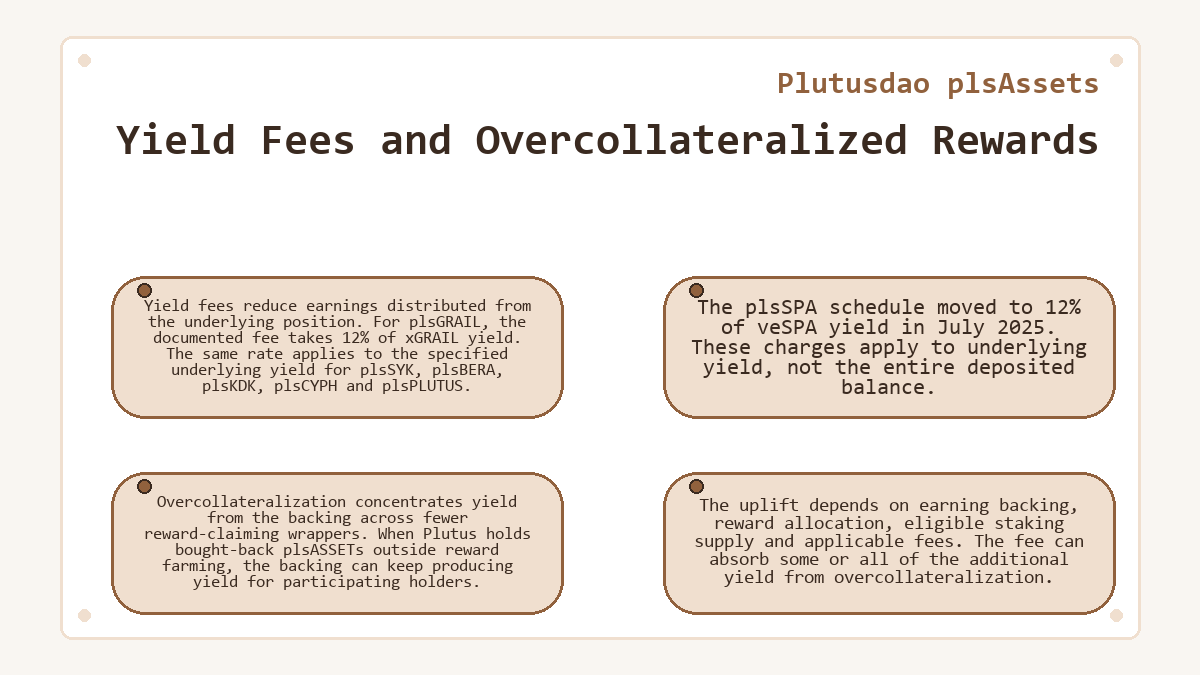
Yield fees reduce earnings distributed from the underlying position. For plsGRAIL, the documented fee takes 12% of xGRAIL yield. The same rate applies to the specified underlying yield for plsSYK, plsBERA, plsKDK, plsCYPH and plsPLUTUS. The plsSPA schedule moved to 12% of veSPA yield in July 2025. These charges apply to underlying yield, not the entire deposited balance.
Overcollateralization concentrates yield from the backing across fewer reward-claiming wrappers. When Plutus holds bought-back plsASSETs outside reward farming, the backing can keep producing yield for participating holders. The uplift depends on earning backing, reward allocation, eligible staking supply and applicable fees. The fee can absorb some or all of the additional yield from overcollateralization.
Buyback Support and the Market Peg
plsASSET buybacks use underlying tokens to acquire wrappers from the market. Those purchases can support pool liquidity and reduce the supply claiming rewards. Product thresholds and market conditions determine the intervention. The Q1 2025 support framework described a soft floor of 0.8 underlying tokens per wrapper. A support target does not create an unconditional redemption entitlement. These purchases differ from PLUTUS buybacks for xPLUTUS rewards: wrapper buybacks support their exchange rate against the backing asset and overcollateralization, while PLUTUS buybacks acquire the protocol token for distribution.
Legacy Wrappers and the Radiant Wind-Down
Plutus discontinued plsJONES and plsARB, stopped minting them and removed most liquidity. Their remaining redemption mechanism allows conversion into the underlying assets.
Radiant Capital announced an orderly DAO wind-down on June 1, 2026. Active development stopped immediately under the announcement. The plan called for RDNT emissions to end while keeping existing contracts available for position management.
Plutus marked its earlier plsRDNT rework and yield descriptions outdated from June 2026. Its wrapper notice deferred plsRDNT unwind details to a later update. The older reward model therefore does not establish an operating staking product or a redemption deadline. Radiant's provision for managing its native positions does not itself establish a plsRDNT conversion route.
Key questions about Plutusdao plsAssets
Does plsSYK Use the Same Underlying Position as Legacy plsDPX?
plsSYK uses Stryke's xSYK, while legacy plsDPX used veDPX. The September 20, 2024 launch introduced a migration alongside Dopex's change to Stryke. An old plsDPX balance and a plsSYK balance therefore identify different underlying token systems, despite their shared product history.
Are Displayed plsGRAIL Performance Figures Already Net of the Yield Fee?
The plsGRAIL performance figures include the 12% fee on underlying xGRAIL yield. A displayed performance figure does not establish the price a holder receives when selling plsGRAIL, because a sale follows the market exchange rate.
Does plsBERA LP Staking Apply sWBERA Yield to the Whole LP Balance?
The sWBERA yield applies to the plsBERA portion of the eligible staked LP position. LP-related incentives can add a separate reward stream under the pool's own arrangements.
Can Unstaking a plsASSET Unlock Its Underlying Backing?
Unstaking a plsASSET does not itself release the underlying position from its lock. It changes the wrapper's staking status and reward eligibility. A market exchange sells the wrapper at the pool's available rate. A product-specific conversion or redemption follows its own terms, including the separate plsPLUTUS-to-xPLUTUS conversion rule.
Did the Q1 2025 Peg Ratios Define a Permanent Exchange Rate?
The Q1 2025 peg ratios recorded market conditions at the report's writing date. The PlutusDAO Quarterly Report published on April 14, 2025, recorded a market ratio of 0.91 GRAIL per plsGRAIL at that time. That figure did not establish a fixed redemption price or the amount available in a later trade.
Are Legacy plsRDNT v1 and v2 the Same Contract as the Newer Token?
The legacy plsRDNT v1 and v2 deployments are separate contracts from the newer listed plsRDNT token. Plutus marks both earlier versions as deprecated in its Arbitrum contract inventory. A shared token name does not merge their balances or prove migration availability after Radiant's wind-down.