 Plutusdao
 links protocol yield and governance through xPLUTUS
· last updatedPlutusdao, now named Plutus, combines DeFi yield products with governance through PLUTUS and its escrowed staking token, xPLUTUS. Revenue-funded token buybacks support rewards for xPLUTUS stakers, who also participate in protocol decisions. Liquid plsASSETs provide exposure to underlying locked positions, while plvASSET vaults automate yield strategies. These products have different voting rights, liquidity and exit mechanisms.
Holding PLUTUS, staking it into xPLUTUS and entering a vault create different positions with distinct exit conditions. Depending on the product, access to funds follows a vesting schedule, a market sale or an available vault withdrawal route.
From PLS to PLUTUS
PRFC-15 established the rebrand from Plutusdao to Plutus and introduced the PLUTUS and xPLUTUS token model, replacing the legacy PLS and bPLS system. The PLS documentation marks its older token rules as applicable until May 27, 2025. Those legacy rules used locking periods and multiplier points within the bPLS reward framework.
The PLS migration into PLUTUS or xPLUTUS closed on March 2, 2026. Historical conversion terms therefore do not establish an available migration route.
A successful governance vote on July 7, 2024 formalized the community-led transition, placing treasury operations and development under community control. This organizational change preceded the later token-model changes.
How Does xPLUTUS Connect Rewards and Voting?
Staking PLUTUS into xPLUTUS at a 1:1 ratio gives holders access to protocol yield and governance voting.
Plutus uses protocol revenue and productive treasury funds to buy PLUTUS for distribution to xPLUTUS stakers. Rewards arrive primarily in PLUTUS, so both the distributed token amount and the token's market price determine their currency value. The amount of PLUTUS those funds can buy also depends on the token's purchase price.
xPLUTUS supplies voting power through Snapshot, with each token counting as one vote on proposals covering budgets, investments and protocol strategy. The earlier bPLS system combined several token balances when calculating voting power.
Liquid Exposure Through plsASSETs
Staked plsASSETs give holders liquid exposure to rewards from underlying governance positions while Plutus aggregates their voting power. This separates the transferable reward-bearing token from the underlying position's direct governance rights. The family includes plsGRAIL, which draws on Camelot's locked xGRAIL exposure, and plsPLUTUS, which applies the liquid-wrapper approach to xPLUTUS itself.
Unstaking a plsASSET does not require a vesting period, and market liquidity provides a route to selling it. Its market price can differ from the underlying asset's value. Buybacks can increase backing per circulating plsASSET and concentrate underlying yield among participating tokens. Minting plsGRAIL commits GRAIL to permanently locked xGRAIL exposure, while purchasing existing plsGRAIL uses the pool's market exchange rate.
What Do Plutus Vaults Automate?
plvASSET vaults automate yield strategies and compound earnings, with exposure determined by each vault's strategy. plvHEDGE began with funding arbitrage and evolved into a multi-strategy vault. plvLOOP uses a looping strategy across multiple assets.
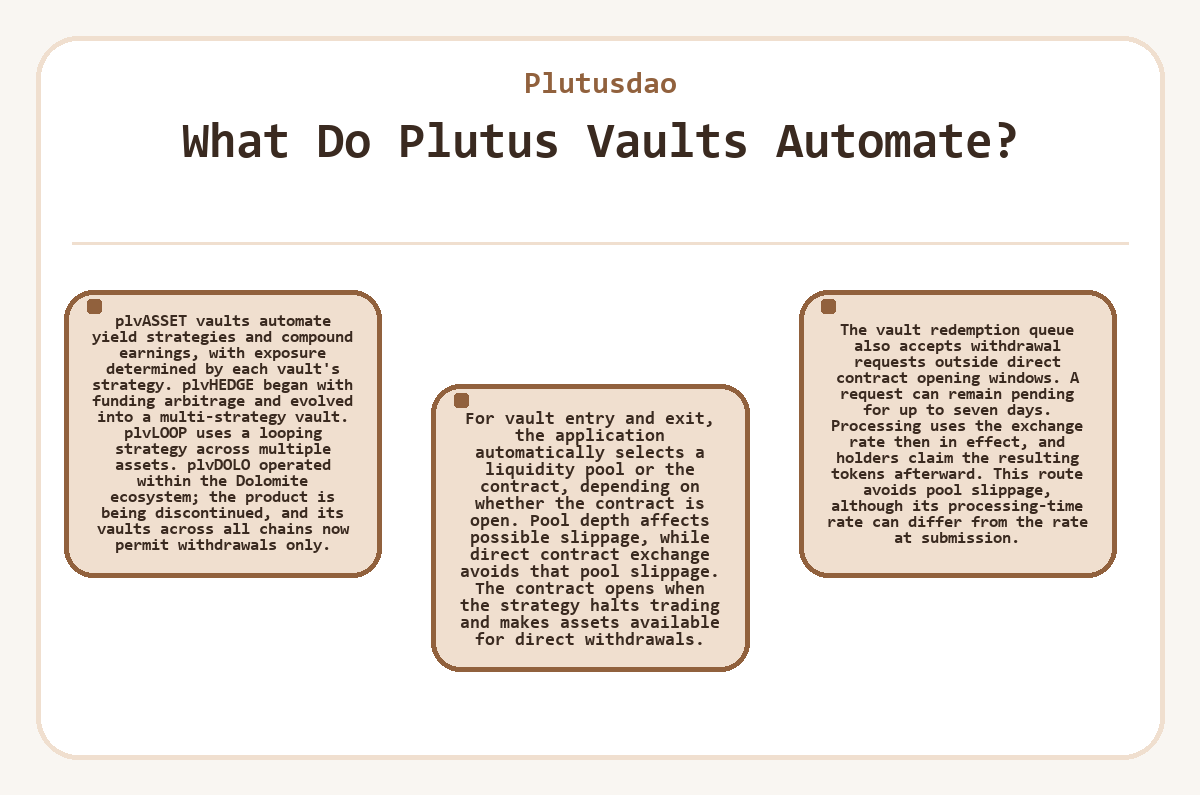
plvDOLO operated within the Dolomite ecosystem; the product is being discontinued, and its vaults across all chains now permit withdrawals only.
For vault entry and exit, the application automatically selects a liquidity pool or the contract, depending on whether the contract is open. Pool depth affects possible slippage, while direct contract exchange avoids that pool slippage. The contract opens when the strategy halts trading and makes assets available for direct withdrawals.
The vault redemption queue also accepts withdrawal requests outside direct contract opening windows. A request can remain pending for up to seven days. Processing uses the exchange rate then in effect, and holders claim the resulting tokens afterward. This route avoids pool slippage, although its processing-time rate can differ from the rate at submission.
Multichain Tokens and the Wider Ecosystem
PLUTUS uses LayerZero's Omnichain Fungible Token standard for transfers between eligible networks, with deployments on Arbitrum and Berachain. xPLUTUS exists on each chain where PLUTUS is deployed. Vault availability follows each vault token's own deployments, so a network's support for PLUTUS alone does not establish access to every strategy.
Plutus is also the parent protocol for Orange Finance, Berancia, Deep Thought and LPfun. Deep Thought uses AI agents for yield hunting, risk management and governance assistance. LPfun focuses on leveraged liquidity-provider farming across chains.
When Can xPLUTUS Be Redeemed for PLUTUS?
xPLUTUS redemption has a minimum 14-day vesting period, returning 0.5 PLUTUS per xPLUTUS at that endpoint. Completing a 180-day xPLUTUS vest allows redemption into PLUTUS at a 1:1 ratio. The ratio increases linearly between those endpoints. The 1:1 staking ratio applies when entering xPLUTUS; the chosen vesting duration determines its redemption ratio.
In this hypothetical example, a holder asks whether redeeming 73 xPLUTUS returns the same amount after the minimum and full vesting periods.
At 14 days, 73 multiplied by 0.5 returns 36.5 PLUTUS; at 180 days, 73 multiplied by 1 returns 73 PLUTUS. The full vest returns 36.5 more PLUTUS from the same redemption amount.
These amounts cover redemption principal, excluding additional rewards and transaction costs. Choosing another vesting duration within the documented schedule changes the conversion ratio and the amount of PLUTUS returned.
Details worth knowing about Plutusdao
Can plsPLUTUS Convert Back Into xPLUTUS?
plsPLUTUS can convert back into xPLUTUS at a 1:1 token ratio through the Plutus application. This conversion differs from selling plsPLUTUS through a liquidity pool, where the market determines the exchange rate. Holding plsPLUTUS also means forgoing the governance rights of the converted xPLUTUS.
Are Vault Performance Fees Charged on the Entire Deposit?
The listed performance fee for plvHEDGE and plvLOOP is 12% of realised profits. The fee base is the strategy's profit, rather than the full deposited balance. Their displayed performance metrics already subtract this fee, so that percentage should not be deducted again from those net figures.
Can I Cancel a Queued Vault Redemption Before It Processes?
A queued vault redemption can be cancelled while its request remains pending. Processing completes the exchange at the processing-time rate, after which the holder can claim the resulting tokens through the application.
What Happened to the bPLS and Vested esPLS Migrations?
The bPLS and vested esPLS migration routes closed on March 2, 2026. The bPLS route targeted xPLUTUS, while vested esPLS could migrate into PLUTUS or xPLUTUS. Those closed legacy conversions are distinct from staking PLUTUS under the newer token model.
Who Can Submit a PRFC Governance Proposal?
Community members with more than 1,000,000 xPLUTUS and the Plutus Team can write PRFC proposals. PRFC means Plutus Request for Comments. This proposal-writing threshold differs from the voting rule, under which each xPLUTUS counts as one vote in the protocol's Snapshot governance.
Does Bridging PLUTUS Cost More Than Network Gas?
Bridging PLUTUS incurs fees in addition to network gas. A transfer uses the LayerZero integration between eligible chains, so the required cost includes both the bridge charge and the relevant network transaction costs.
Is the Superseed plvHEDGE Vault Open to New Deposits?
The Superseed plvHEDGE vault is discontinued and operates in withdrawal-only mode. plvHEDGE has active deployments on Arbitrum, Berachain and Ethereum Mainnet, so Superseed's withdrawal restriction applies to that network's vault.
Which Token Pays plsGRAIL Staking Rewards?
plsGRAIL staking rewards pay out in GRAIL. The underlying position earns yield through permanently staked xGRAIL, and Camelot determines the rewards Plutus passes to plsGRAIL stakers.